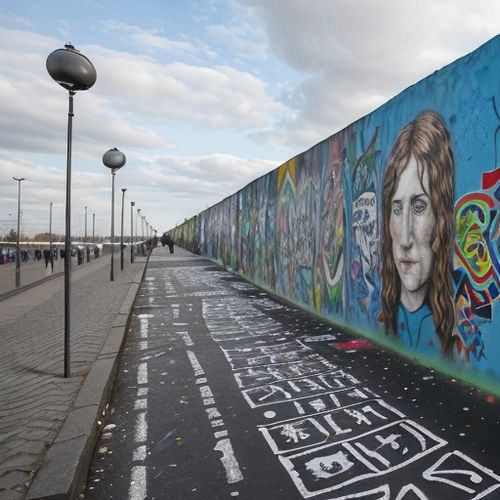
The iconic East Side Gallery in Berlin, a 1.3-kilometer stretch of the Berlin Wall covered in politically charged murals, is facing an unexpected environmental challenge. As the vibrant artworks gradually fade and peel under relentless weather conditions, conservationists have stumbled upon an unusual opportunity – to test cutting-edge eco-friendly protective coatings that could revolutionize urban art preservation worldwide.
For decades, the concrete canvas has borne witness to both artistic expression and natural decay. The latest scientific analysis reveals that traditional acrylic and polyurethane sealants applied in previous restoration attempts have accelerated deterioration in some sections. "We're observing micro-cracking patterns that correlate with temperature fluctuations," explains Dr. Lena Hartmann, materials scientist at TU Berlin. "The old coatings become brittle in winter, then trap moisture during summer humidity, creating ideal conditions for substrate erosion."
Enter a consortium of German chemical startups collaborating with street artists to trial bio-based alternatives. Their flagship product, derived from modified cactus mucilage and recycled silica, forms a breathable membrane that reportedly withstands -15°C to 45°C without losing elasticity. Early morning application tests on the "Fraternal Kiss" mural section showed promising results after eight months of exposure. "The molecular structure allows CO2 exchange while blocking sulfur dioxide from traffic emissions," notes Hartmann, whose team monitors the experiment with hyperspectral imaging.
Meanwhile, across the Spree River, another innovation emerges from an unexpected source. A Berlin-based graffiti collective accidentally discovered that their mushroom-derived ink binder possesses remarkable UV-resistant properties. "We were just trying to make our paints non-toxic," admits collective member Jannis Kohl. "But when we noticed our tags outlasting conventional spray paints by threefold, researchers got interested." The fungal chitosan compound, now being refined by Fraunhofer Institute, could offer dual functionality as both pigment and protective layer.
These developments coincide with mounting pressure from UNESCO, which considers the East Side Gallery's deterioration a case study in climate change's impact on cultural heritage. The organization recently funded the installation of microclimate sensors along the wall, creating the world's first open-air laboratory for urban art preservation. Data from these devices reveals startling variations in surface temperature – up to 12°C differences between shaded and sun-exposed areas – challenging conventional conservation approaches.
Critics argue that such interventions fundamentally alter the ephemeral nature of street art. "The wall was never meant to be permanent, neither physically nor symbolically," contends art historian Prof. Matthias Bauer. Yet proponents counter that the gallery's transition from political barrier to cultural monument obligates preservation. The debate grows more complex as chemical analyses detect increasing concentrations of tire-wear particles and microplastics embedded in the artworks' porous surface.
As autumn winds begin stripping another layer of paint from the famous "Trabant breaking through the wall" mural, researchers race against time. Their next trial involves a self-regulating nanocomposite coating containing dormant limestone-producing bacteria. When activated by rainwater acidity, these microorganisms theoretically deposit protective calcite layers – an approach inspired by coral reef formation. Early-stage testing suggests the technology could extend artwork lifespan by 15-20 years without altering visual characteristics.
The implications extend far beyond Berlin. From São Paulo's concrete jungles to Melbourne's laneways, urban art districts worldwide grapple with similar preservation dilemmas. What emerges from this accidental laboratory along the Spree may well redefine how cities safeguard their unofficial cultural heritage in an era of climatic extremes. As the afternoon sun casts long shadows across the peeling portraits of revolutionaries and doves, one truth becomes clear – the wall continues to transform, not just as art, but as a testing ground for humanity's evolving relationship with impermanence.
Behind the scenes, an international team of conservators, materials scientists, and street artists convene monthly in a Kreuzberg warehouse, their discussions punctuated by the rattle of passing trains. Their shared challenge: developing protocols for "ethical preservation" that honor street art's rebellious spirit while preventing its disappearance. The current focus involves creating region-specific formulas – coatings tailored to Mumbai's monsoon humidity or Los Angeles' photochemical smog.
Unexpected partnerships flourish in this interdisciplinary space. A traditional Japanese lacquer master recently collaborated with bioengineers to adapt urushi techniques for concrete substrates. The resulting hybrid varnish, incorporating persimmon tannins and graphene oxide, shows exceptional promise in preliminary tests. Meanwhile, Berlin's public works department experiments with photocatalytic coatings that not only protect art but actively break down air pollutants – turning the gallery into a passive air purification system.
As winter approaches, researchers prepare for the ultimate stress test. The coming freeze-thaw cycles will reveal whether these experimental treatments can outperform conventional methods. Whatever the outcome, the project has already shifted paradigms in conservation science. "We're learning that preserving urban art requires understanding street chemistry as much as materials science," reflects Dr. Hartmann, brushing snowflakes from a test panel. The Berlin Wall's final irony may be this: a structure once dividing a city now unites global expertise in the shared mission to protect vulnerable beauty.
By Daniel Scott/Apr 12, 2025
By Emily Johnson/Apr 12, 2025
By Sarah Davis/Apr 12, 2025
By Ryan Martin/Apr 12, 2025
By Emma Thompson/Apr 12, 2025
By George Bailey/Apr 12, 2025
By Rebecca Stewart/Apr 12, 2025
By Elizabeth Taylor/Apr 12, 2025
By Samuel Cooper/Apr 12, 2025

By James Moore/Apr 12, 2025
By David Anderson/Apr 12, 2025
By George Bailey/Apr 12, 2025
By Sarah Davis/Apr 12, 2025
By Benjamin Evans/Apr 12, 2025
By Michael Brown/Apr 12, 2025
By Victoria Gonzalez/Apr 12, 2025

By David Anderson/Apr 12, 2025
By David Anderson/Apr 12, 2025
By Olivia Reed/Apr 12, 2025
By Rebecca Stewart/Apr 12, 2025